Interview with our donors : Servants of the Sacred Heart of Mary
17 April 2026|Joanna Kozakiewicz
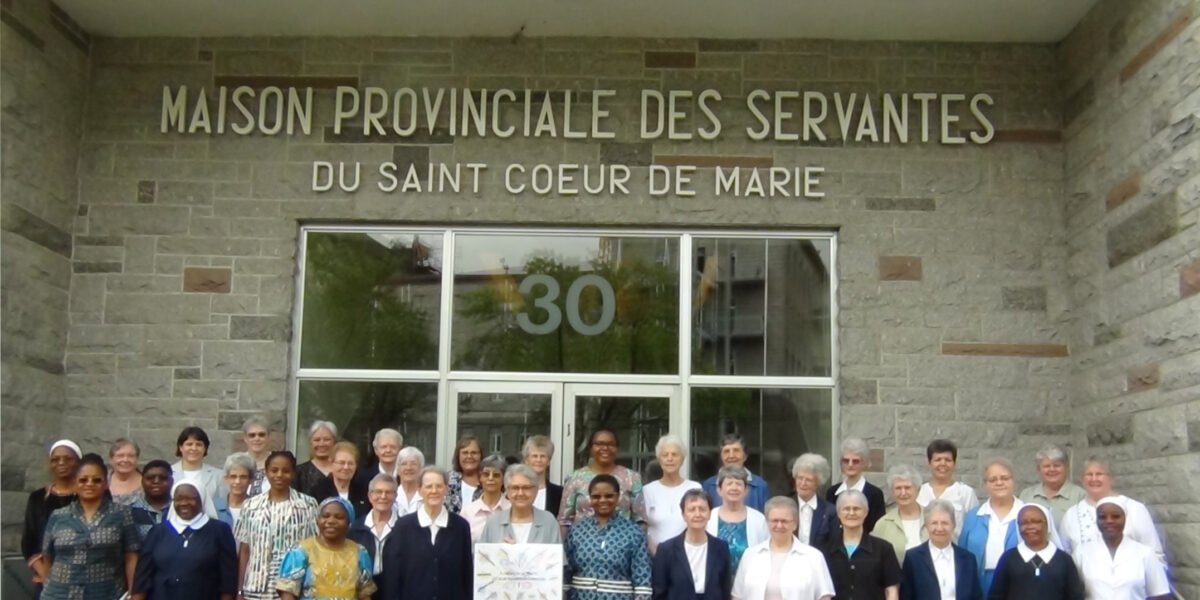
Born from the missionary spirit of their founder, Reverend Father François-Jean-Baptiste Delaplace, C.S.Sp., the Sisters Servants of the Sacred Heart of Mary continue to work in the image of his devotion for families facing unemployment and misery of all kinds.
In 1860, Father Delaplace inaugurated a charitable work for orphans and abandoned children. This project was initially conceived as a charitable work, but then, through God’s plan, it became a new religious congregation.
The Sisters Servants of the Sacred Heart of Mary have been involved in the cause of refugees, migrants, and forcibly displaced persons as donors for the Jesuit Refugee Service in Canada since 2020.
Sr. Maria Margarita Hernandez Fernandez, Superior General of the congregation, agreed to answer a few questions for JRS Canada.
JRS Canada: Why are the Sisters Servants of the Sacred Heart of Mary involved in the cause of refugees, migrants, and forcibly displaced persons?
Sr. Maria Margarita Hernandez Fernandez:
Our Congregation was born from a call to be close to people who are abandoned and vulnerable. In the name of our faith, in different ways and according to our contexts and possibilities, we are called to offer them welcome, presence, closeness, a home, education, dignity, humanity, and our faith in Jesus Christ.
Refugees, migrants, and displaced persons are today one of the most vulnerable and suffering groups, facing insecurity, persecution, violence, confusion, family breakdown, loneliness, inhumane living conditions… At the same time, it is one of the most complex problems to deal with from a social, ethical, economic, and political point of view, both for poor countries and for countries that are called to welcome them.
As a religious congregation, we are present in three countries in the North, which receive or deport immigrants, and five in the South, which are heavily affected by migration and displacement.
JRS Canada: How does supporting the cause of refugees fit into your mission?
Sr. Fernandez: In 1860, Father Francois Delaplace was moved by the abandoned state of little orphan girls who roamed the streets of Mouffetard and poor families whom he accompanied to the Work of the Holy Family (Œuvre de la Sainte-Famille) at the Seminary of the Holy Spirit in Paris. With the help of Jeanne Marie Moisan, he opened the Orphanage of the Holy Family, a work that later became the Congregation of the Sisters Servants of the Holy Heart of Mary. For 166 years, the Servants of the Holy Heart of Mary have been trying, wherever we are and with whatever means we have, to remain close to the most helpless and destitute, especially children, women, and families, and to make a difference in terms of their human dignity and their status as children of God. Today, migrants, refugees, and displaced persons are the greatest victims of dehumanization, abuse of power, and violence.
JRS Canada: What is the responsibility of a Sister Servant of the Sacred Heart of Mary towards refugees?
Sr. Fernandez: Each sister or community group commits according to its context, its calling, and its possibilities: interest and prayer, welcome and integration (for example: language learning, assistance with legal and immigration procedures, spaces for fellowship, listening and support, sacramental initiation and accompaniment in the faith…), humanitarian aid (through organizations, volunteering, community kitchens, clothing banks, assistance with housing, etc.), support for volunteers and reception organizations at the borders, financial support for organizations committed to the cause and making a real difference (such as the JRS).
JRS Canada: What changes would you like to see in the world for refugees, forcibly displaced persons, and migrants?
Sr. Fernandez:
- The opening of hearts of individuals, peoples, institutions (including the Church), and politicians… to see them as brothers and sisters, and not as a threat. Therefore, educating sensitivity and humanity.
- An end to violence, abuse of power, and policies that keep people in poverty and prevent their development.
- The proliferation of organizations like JRS that can make a real and broad difference in improving support mechanisms.
- More open, responsive, and effective laws and policies that better address this scourge and support individuals, families, and populations.
JRS Canada: What would you say to those who oppose this cause?
Sr. Maria Fernandez: We are all brothers and sisters, with the same rights to freedom, dignity, humanity… Sharing our resources and our spaces is a duty, but also a path to development, growth, and humanity, which is beneficial for all. So, let’s work together to find intelligent and human ways to achieve this.
JRS Canada: What encouragement do you have for donors (or other religious communities) who are unsure whether they should support us this year?
Sr. Fernandez: You are committed with professionalism and humanity to ensuring real change for migrants, refugees, displaced persons, etc., both at the global level (transforming laws, collaborating with other organizations, creating institutions, etc.) and on the ground, working with victims. You manage the money we share with you with justice, intelligence, efficiency, and creativity, in the service of the people and populations affected by this scourge. So you allow us to remain “on mission,” now that we are so limited by age and declining numbers; you “extend our arms” and give life to our charism.
Thank you from the bottom of our hearts!